

Part 2 of 2: Non-Compliant Taxpayers, Economic Assessment, and the Cost of Refusal
By Les Bryson, The LAB Business Solutions (thelab.tax) | Blake Peters, EA, Peters Specialty Tax Services (petersspecialtytax.com)
Part 1 of this series established the §174/§41 statutory linkage and laid out the clean paths available to compliant taxpayers (Situations 1 and 2). Read here. This article addresses the situations most practitioners are refusing, non-compliant taxpayers, and provides the complete Economic Assessment Framework that must precede any filing decision, regardless of situation.
Situation 3: Non-Compliant Small Business Taxpayers and the Clean Path
This is where the practitioner’s refusal most clearly fails. SBT-eligible taxpayers who never complied with TCJA §174 and who continued to deduct domestic R&E immediately through 2022–2024 have a path to resolve both the §174 compliance issue and their prior-year credit opportunity in a single set of coordinated filings.
The Mechanism: Rev. Proc. 2025-28 §3.03
The small business OBBBA election under OBBBA §70302(f)(1)(A), implemented through Rev. Proc. 2025-28 §3.03, retroactively applies §174A to domestic R&E expenditures paid or incurred in taxable years beginning after December 31, 2021. This election is made on amended returns (or AARs for BBA partnerships) for each applicable year.
When an SBT makes this election on an amended return, the expenditures for that year are now “treated as” domestic R&E expenditures under §174A. The §41(d)(1)(A) requirement is satisfied. The amended return can simultaneously include the Form 6765 credit claim. A §280C(c)(2) election or revocation can also be made on the same amended return by July 6, 2026, or the statute of limitations deadline, whichever comes earlier.
This is not a novel legal position. It is explicitly authorized by statute and operationalized by Rev. Proc. 2025-28. Practitioners refusing this work for SBT clients are not being conservative, they are denying clients a benefit Congress specifically created and intended for them.
Consistency Requirement
A taxpayer cannot selectively elect §174A treatment for some years and not others. The §3.03 election must be applied consistently across all applicable taxable years from 2022 through 2024 in which the taxpayer paid or incurred domestic R&E expenditures.
Situation 4: Non-Compliant Non-SBT Taxpayers and a More Complex Path
This is the most nuanced situation. For taxpayers above the $31M gross receipts threshold who never complied with TCJA §174, the retroactive §174A election is not available. A different set of steps is required, and the economics are more complex.
Step 1: Economic Assessment Before Anything Else
No forms should be filed, and no elections should be made before a thorough economic assessment is completed. The assessment must be done first, and it will determine whether any action is warranted at all. See the Economic Assessment Framework section below.
Step 2: The §7.01 Method Change to Establish TCJA §174 Compliance
For a non-SBT taxpayer who wishes to pursue 2022–2024 R&D credits, the path to satisfying the §41(d)(1)(A) requirement for those years runs through an accounting method change. Specifically, the taxpayer must file a Form 3115 under Rev. Proc. 2025-28 §7.01 to change their method of accounting for 2022–2024 domestic R&E expenditures to comply with TCJA §174.
This Form 3115 generates a modified §481(a) adjustment representing a positive income inclusion spread over four years beginning with the year of change, reflecting the excess deductions taken over what TCJA §174 would have allowed. This is the “claw back” of prior deductions. Separately, a Form 3115 under §7.02 should be filed to adopt §174A(a) as the method for 2025 and forward domestic R&E on a cut-off basis with no §481(a) adjustment for prior years.
Step 3: Coordinated Amended Returns for Credits
With the §7.01 method change establishing that the 2022–2024 domestic R&E expenditures are now properly treated under TCJA §174, the taxpayer can file amended prior-year returns claiming R&D credits for open years. The Form 3115 and the amended returns together put the taxpayer in substantially the same position as if they had complied originally: they give back the excess deductions through the §481(a) income inclusion and claim the corresponding credit benefit for those years.
Important Disclosure — Situation 4 Coordinated Filing Approach
The coordinated filing approach for Situation 4 involves filing a §7.01 Form 3115 to establish TCJA §174 compliance and simultaneously pursuing prior-year credit claims on amended returns. It is a well-reasoned professional position supported by the statutory framework and the logic of Rev. Proc. 2025-28.
However, it has not been explicitly blessed by IRS guidance in the same way that the SBT retroactive election under Rev. Proc. 2025-28 §3.03 has been. Taxpayers and practitioners should treat the Situation 4 path as a disclosed professional position, not settled law. Given this uncertainty, the economic case must be particularly compelling to justify the effort and the disclosure risk.
The Economic Assessment Framework: Required for All Taxpayers
Regardless of which situation a taxpayer is in, no filing decisions should be made without a complete economic assessment. The assessment determines whether the available benefit justifies the compliance cost.
1. Identify and Quantify All R&E Spending (2022–2025)
A complete picture of domestic versus foreign R&E spending across all open years is essential. Foreign R&E remains subject to 15-year amortization under amended §174 regardless of the OBBBA changes. If a significant portion of the taxpayer’s R&E is foreign, the benefit of the domestic credit and deduction path is proportionally reduced. Do not assume all R&E is domestic. Verify.
2. Determine SBT Eligibility and Open Years
Confirm the §448(c) gross receipts test result, including controlled group aggregation rules. Then map the §6511 statute of limitations for each year. Under §6513(a), a return filed before its due date is treated as filed on the due date. Calendar year 2022 returns filed April 17, 2023 were subject to a three-year SOL expiring April 17, 2026. This deadline has passed so a claim for refund is not viable. Returns filed on extension may still be open. Verify each year individually.
3. Model the Credit Refund Potential
Quantify the R&D credit available under §41 for each open year. Account for the §280C(c) interaction by reducing the R&E deduction or capital account under §280C(c)(1) or by electing a reduced credit under §280C(c)(2). Model both scenarios and identify which produces the better net result.
4. Calculate the §481(a) Adjustment (Situations 3 and 4)
For non-compliant taxpayers, calculate the excess deductions taken in each year compared to what TCJA §174 would have allowed. For Situation 3 SBTs using the retroactive §174A election, the §174A deduction is the full amount, so the adjustment math differs from the TCJA §174 path. For Situation 4 non-SBTs using the §7.01 Form 3115, the adjustment is based on the difference between actual deductions taken and TCJA §174 amortization. This income inclusion is a real tax cost spread over four years and must be modeled against credit refunds.
5. Consider Cash Flow Timing
Credit refunds come from prior years and represent incoming cash. The §481(a) income inclusion hits the current and next three years as future tax cost. The timing mismatch can be favorable or unfavorable depending on the taxpayer’s current and projected tax situation, including current-year income levels, rate changes, and the §163(j) interest deduction limitation, which treats accelerated recovery and certain §481(a) adjustments as amortization for ATI purposes.
6. Assess Entity Type and Pass-Through Considerations
For partnerships subject to the Bipartisan Budget Act (BBA) centralized audit rules, AARs are filed in lieu of amended returns. The §481(a) adjustment, credit allocations, and K-1 revisions flow differently for pass-through entities and must be modeled at both the entity and owner levels to capture the true economic impact.
The Decision: Only after this analysis is complete should the taxpayer and their advisors decide whether to proceed, and if so, which path to take. Informed consent is not a courtesy, it is an obligation.
Why the Practitioner Refusal Is Wrong and What It Costs Clients
The practitioners refusing to pursue 2022–2024 R&D credit work are reading the §41(d)(1)(A) compliance linkage correctly in isolation, and then drawing the wrong conclusion from it. The linkage is real. For TCJA years, expenditures must be charged to a capital account under §174 to qualify as QREs. A taxpayer who never capitalized has a real but non-fatal statutory problem. Acknowledging this is intellectually honest.
What these practitioners are missing is that the OBBBA was specifically designed to fix the §174 amortization problem. Treasury operationalized the fix in Rev. Proc. 2025-28 with detailed procedures covering various taxpayer types. Where fact patterns were omitted, the path is open until additional guidance is provided. We must use the guidance we have and apply it to the best of our ability.
For SBT clients, refusing the work means denying clients a benefit that Congress specifically legislated for them, with explicit IRS procedural support. That is not a conservative professional posture, it is a failure of service.
For non-SBT non-compliant clients, a case-by-case economic assessment is genuinely required. But “I need to analyze this carefully” and “I refuse to do this work” are very different professional responses.
Summary: Available Paths by Taxpayer Situation
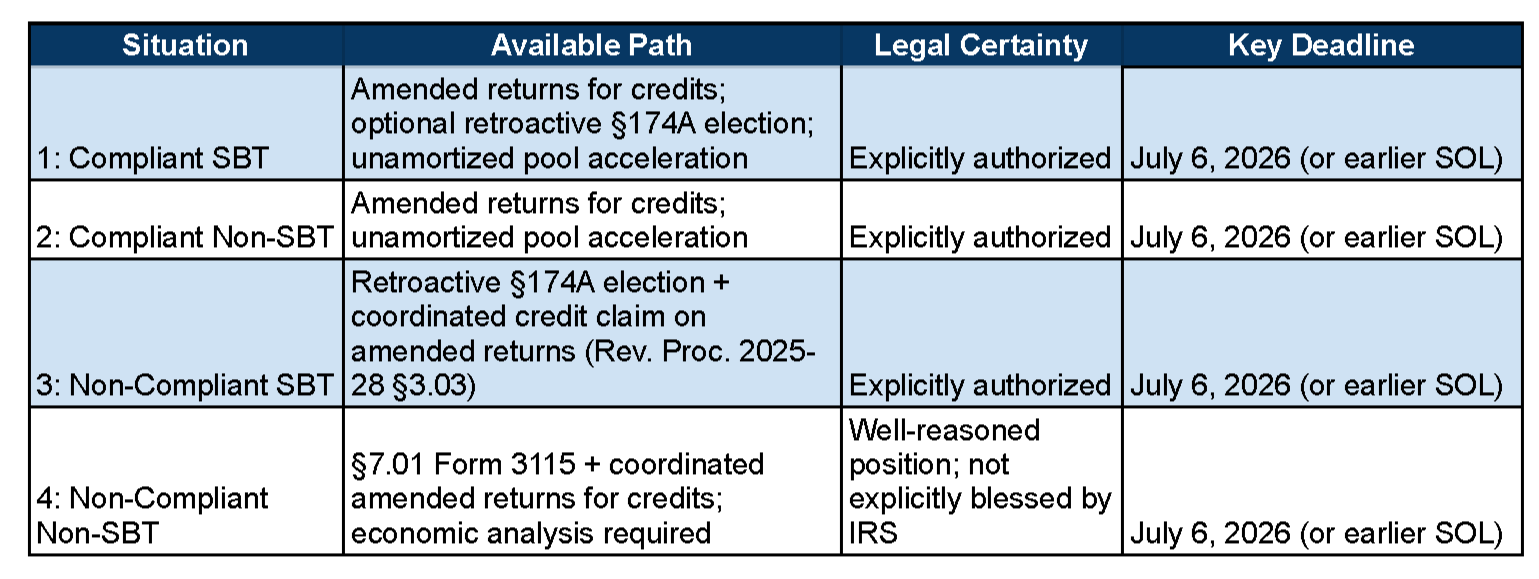
A Note on 2025 and Forward
For all taxpayers, regardless of prior compliance history, the 2025 return is the first year governed by §174A. The §41(d)(1)(A) requirement for 2025 and forward is that domestic R&E expenditures “are treated as” domestic R&E expenditures under §174A.
Taxpayers who deduct R&E on their 2025 returns without filing the required statement in lieu of Form 3115 formally adopting §174A(a) have not established an authorized method. The statement must be filed with the original 2025 return.
Taxpayers who miss the statement on the original return have one remaining opportunity: filing a superseding return before the extended due date. Once the extended due date passes, a formal §174A method adoption for 2025 cannot be accomplished on an amended return, it requires a Form 3115 filed prospectively with the 2026 return. This is a compliance issue that will affect many clients in 2026, and practitioners should be alert to it now.
Conclusion
The OBBBA and Rev. Proc. 2025-28 have provided a genuine and workable framework for addressing both the TCJA §174 compliance issue and R&D credit opportunities for 2022–2024. The framework is not simple; it requires careful analysis of each taxpayer’s situation, including their SBT eligibility, prior compliance history, the domestic versus foreign composition of their R&E, and the economics of the available paths. This is a framework, not a barrier.
Model the economics. Inform the client. Then file the right forms in the right sequence.
Clients who have been told their 2022–2024 credits are simply unavailable deserve a second opinion. The law has given them a window. That window, for most taxpayers, closes July 6, 2026.
Disclaimer: This article is intended for informational purposes only and does not constitute legal or tax advice. The analysis presented reflects the authors’ professional interpretation of applicable law and IRS guidance as of the date of publication. Taxpayers should consult qualified tax counsel before making any elections or filing decisions. The coordinated filing approach described for non-SBT non-compliant taxpayers (Situation 4) represents a well-reasoned professional position that has not been explicitly confirmed by IRS guidance and should be approached accordingly.
Leave a Reply