

1 of 2: The Legal Framework for Compliant Taxpayers
By Les Bryson, The LAB Business Solutions (thelab.tax) | Blake Peters, EA, Peters Specialty Tax Services (petersspecialtytax.com)
Introduction
In working with our clients over the past year, we have heard a troubling pattern emerging in the R&D tax credit community. Some practitioners are refusing to pursue research and development credits for tax years 2022 through 2024 specifically for clients who never complied with the capitalization requirements imposed by the Tax Cuts and Jobs Act (TCJA) of 2017. These taxpayers continued to immediately deduct domestic research and experimentation (R&E) expenditures incurred during 2022–2024, instead of capitalizing and amortizing them as required under TCJA §174. The refusal is not entirely without basis: the statutory linkage between IRC §174 and §41 is real, and practitioners are right to take it seriously. But refusing or ignoring the work entirely is the wrong conclusion.
The One Big, Beautiful Bill Act (OBBBA), signed into law on July 4, 2025, and the IRS guidance that followed (principally Revenue Procedure 2025-28) provide clear, IRS-sanctioned paths to resolve both the §174 compliance issue and the prior-year credit question simultaneously. For most taxpayers, the question is not whether these credits are available. The question is whether the economics justify the effort.
This article – the first of two – provides a framework for CPAs and their clients to understand exactly what the law allows for compliant taxpayers (Situations 1 and 2 in the table below). Part 2 addresses non-compliant taxpayers, the economic assessment framework, and why practitioner refusals fail their clients. No election should be made, no Form 3115 accounting method change should be filed, and no amended return should be submitted until that analysis is complete.
Background: The §174/§41 Linkage That Created the Problem
What TCJA Required (2022–2024)
Before 2022, domestic R&E expenditures under IRC §174 (“Old §174”) could be deducted immediately in the year incurred. The TCJA modified Old §174 such that for taxable years beginning after December 31, 2021, all domestic R&E expenditures were required to be capitalized and amortized over five years (using a midpoint convention), and foreign R&E over fifteen years. Many small and mid-sized businesses were unaware of this change or did not update their accounting methods accordingly, continuing to deduct R&E expenditures as they always had.
The §41(d)(1)(A) Linkage: Why It Matters
The TCJA version of IRC §41(d)(1)(A), in effect for tax years 2022 through 2024, defines “qualified research” as research “with respect to which expenditures may be treated as specified research or experimental expenditures under section 174.” The OBBBA changed this language to read, “with respect to which expenditures are treated as domestic research or experimental expenditures under section 174A.” The operative syntax shift from “may be treated as” to “are” means that a taxpayer who did not capitalize R&E expenditures under TCJA §174 has a statutory argument working against their credit claim for those years. This is the legitimate basis for practitioner concern. It is not, however, a permanent bar.
What the OBBBA Changed
The OBBBA restored immediate deductibility for domestic R&E expenditures by enacting new IRC §174A, effective for taxable years beginning after December 31, 2024. Under §174A(a), the default treatment is an immediate deduction. The election under §174A(c) to capitalize and amortize over at least 60 months is now the exception. Foreign R&E expenditures remain subject to 15-year amortization under amended §174 and are not affected by the §174A changes. Critically, post-OBBBA §41(d)(1)(A) still uses the mandatory word “are” so the compliance linkage between R&E treatment and credit eligibility remains intact. What changed is that Congress simultaneously created explicit remediation paths to satisfy that linkage retroactively for prior years.
Four Taxpayer Situations: One Framework
Before addressing the available paths, it is essential to identify which of four situations a taxpayer is in. The available options, the legal certainty of each path, and the economics differ materially depending on this classification.
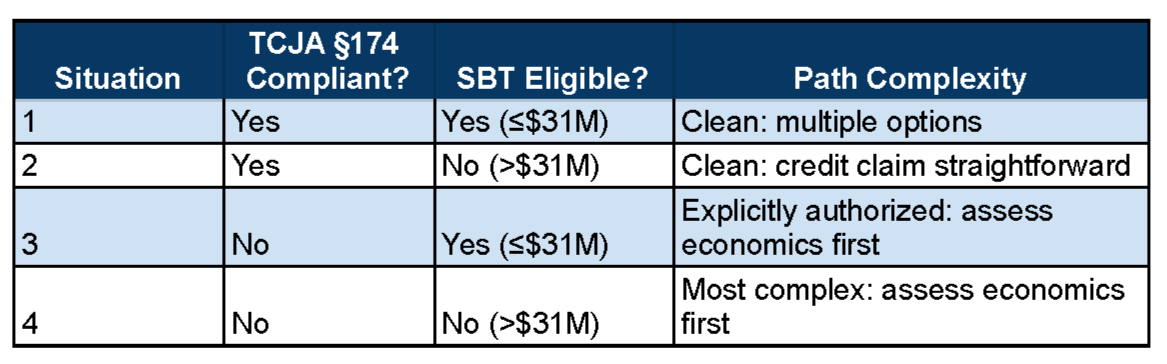
Small Business Taxpayer (SBT) eligibility is determined by the §448(c) gross receipts test: average annual gross receipts for the three prior taxable years of $31,000,000 or less (inflation-adjusted for 2025). Controlled group aggregation rules apply, meaning all entities under common ownership are treated as one taxpayer for this purpose.
Situation 1: TCJA-Compliant Small Business Taxpayers
Taxpayers who properly capitalized and amortized domestic R&E under TCJA §174 for 2022–2024 and meet the SBT gross receipts test have the broadest and cleanest set of options under the OBBBA. It is worth noting that taxpayers who went through the discipline of TCJA §174 compliance almost certainly also claimed their R&D credits for those years. Situations 1 and 2 are therefore included primarily as context and to address 2025 forward planning steps that remain relevant for all compliant taxpayers.
For Prior Years (2022–2024): Amended Returns for Credits
Because these taxpayers properly treated their R&E expenditures under TCJA §174, the §41(d)(1)(A) “are treated as” requirement is satisfied for those years. Amended returns claiming R&D credits for open years under §6511 are available without any method change complication. The §280C(c) interaction must be addressed, either through a reduction in the amortizable capital account under §280C(c)(1) or through a reduced-credit election under §280C(c)(2).
The OBBBA also provides SBT-eligible taxpayers with an additional option: the retroactive §174A election under OBBBA §70302(f)(1)(A), implemented per Rev. Proc. 2025-28 §3.03. This election retroactively applies §174A to 2022–2024, converting capitalized treatment to immediate deductions. This is a powerful refund opportunity, but it must be coordinated with any credit claims and §280C(c)(2) elections on the same amended returns.
For Going Forward (2025): Two Actions Required
These taxpayers must take two separate and independent actions on their 2025 returns:
- File a statement in lieu of Form 3115 (per Rev. Proc. 2025-28 §7.02) to formally adopt §174A(a) or §174A(c) as their method for new 2025 domestic R&E expenditures. Without this statement, no authorized method has been adopted for 2025 domestic R&E, since TCJA §174 no longer applies to domestic expenditures after December 31, 2024.
- Consider the recovery of unamortized amount election under OBBBA §70302(f)(2), implemented via a separate statement. This allows the remaining unamortized 2022–2024 R&E pool to be deducted either in full in 2025, or ratably over 2025 and 2026. This is separate from the §174A method adoption and requires its own analysis.
Critical Deadline — Situation 1
Tax returns for 2022–2024 must be amended to apply retroactive §174A elections: By July 6, 2026, or the §6511 statute of limitations for a specific tax year, whichever is earlier.
2022 calendar-year returns filed April 15, 2023: SOL expired April 15, 2026 for most. Returns filed on extension may still be open. Verify the specific filing date before assuming a year is closed.
2025 §174A method statement: Due with the original 2025 return (including extensions).
Situation 2: TCJA-Compliant Non-SBT Taxpayers
Taxpayers above the $31M gross receipts threshold who properly capitalized and amortized domestic R&E under TCJA §174 for 2022–2024 have a straightforward path for prior-year credits. Their R&E was properly treated under §174, the §41(d)(1)(A) linkage is satisfied, and amended returns claiming credits for open years are available. As with Situation 1, a taxpayer diligent enough to comply with TCJA §174 capitalization was almost certainly already working with advisors who claimed available R&D credits. The primary action items for this group are forward-looking.
The retroactive §174A election is not available to this group. Their options for 2022–2024 are limited to: (a) continuing existing amortization schedules, or (b) using the recovery of unamortized amount election under OBBBA §70302(f)(2) to accelerate the remaining pool into 2025 or ratably over two years.
For 2025 and forward, the same two-action requirement applies as in Situation 1: the §174A method statement (per Rev. Proc. 2025-28 §7.02) and, separately, the unamortized pool election if acceleration is desired.
What’s Next: Part 2
Part 2 of this series addresses the situations that require the most careful navigation: non-compliant small business taxpayers (Situation 3), who have a path that practitioners are wrongly refusing; and non-compliant non-SBT taxpayers (Situation 4), the most complex scenario. Part 2 also presents the complete Economic Assessment Framework that must precede any filing decision, regardless of situation, and closes with a direct assessment of why practitioner refusals fail their clients.
The window for most taxpayers closes July 6, 2026. Clients who have been told their 2022–2024 credits are simply unavailable deserve a second opinion.
Disclaimer: This article is intended for informational purposes only and does not constitute legal or tax advice. The analysis presented reflects the authors’ professional interpretation of applicable law and IRS guidance as of the date of publication. Taxpayers should consult qualified tax counsel before making any elections or filing decisions.
Leave a Reply